You can plan a menu down to the last canapé and rehearse the first dance, but you cannot book the weather. At a country venue, that one unbookable variable quietly shapes everything else: where the ceremony happens, how guests move between buildings, where the coats go, and whether the dance floor sits forty metres from the bar under an open sky. Choosing between a barn and a marquee is, at heart, a choice about how much uncertainty you want to carry on the day.
Rain-Proof Is a Route, Not a Roof
Most couples ask the wrong question. "Will it rain?" has no answer worth planning around. A better one: what happens in the fifteen minutes before the ceremony if a shower arrives? Where do guests wait, is the walk between buildings covered, who decides to move things inside, and when?
A single named decision-maker and a simple trigger solve most of this. For example: if it is raining at two o'clock, the ceremony sets up in the barn and someone texts the celebrant. That sentence, agreed in advance, prevents the worst possible outcome, which is a hundred people standing in a doorway waiting for instructions while the string quartet plays to empty chairs.
Wind deserves its own paragraph, because it troubles marquees more often than rain does. Side walls flap, linings billow, table plans take off. Ask your supplier how the structure is anchored: ground stakes on grass, ballast weights on gravel or asphalt. Irrigation pipes and drainage runs under a lawn can rule out stakes entirely, so tell them what lies beneath the grass before they quote.
The Barn: Weather-Proof by Default
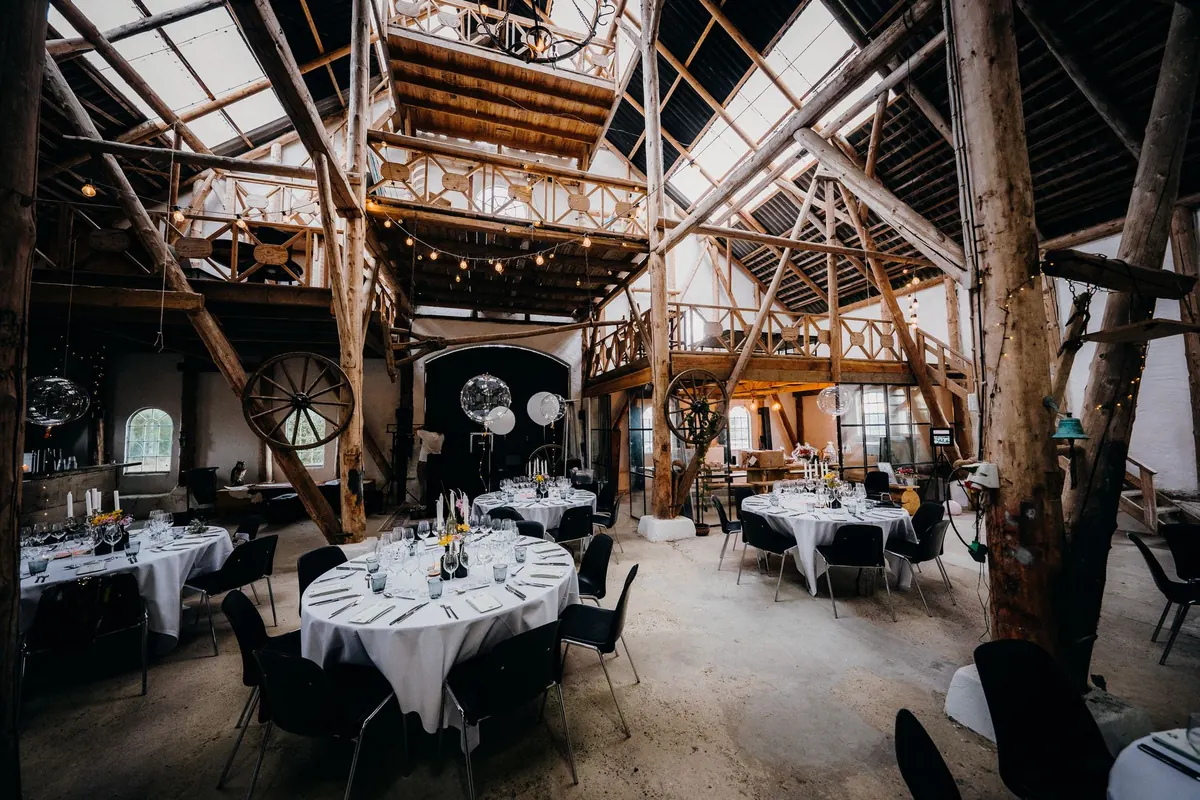
Solid walls do a great deal of quiet work. Rain becomes a sound on the roof rather than a problem to solve, and the day continues with its timing intact. In shoulder seasons, late September or early October, the barn is often the reason a wedding still feels comfortable rather than brave.
What a barn asks in return is honesty about its limits. Capacity is fixed by the walls, exits and floor space, and the dance floor, band and cake table all come out of the same square metres. Hard surfaces bounce sound, so speeches can ring and echo until you add textiles: tablecloths, drapes, upholstered seating, and guests themselves. Warm summer evenings inside thick stone can be stuffier than you expect, so ask about doors that open, fans and cross-ventilation. And check where you are allowed to hang things, because old beams are beautiful but not always structural.
The Marquee: Open Air With a Roof
A marquee does something a barn cannot. It puts guests inside the view instead of looking out at it, which is why so many rural weddings end up under canvas when the forecast is decent and the guest list is long. It also buys flexibility: a smaller marquee for dancing, a larger one for dinner, or the barn for dinner and canvas for the party.
Budget your attention for the infrastructure, not just the pretty parts. A marquee needs, as a minimum: at least one set of side walls even in July, flooring over grass for the dance floor, heating for the evening temperature drop, lighting on the path from the car park, and a generator sited far enough away that guests at the top table cannot hear it. Drainage matters too. A marquee standing over a low corner of a field will find the water.
Ask early who is responsible for permissions. Larger temporary structures, or ones standing for longer than a set period, may require approval from the local authority or the venue's insurer. Confirm in writing who arranges what, and take professional advice on the permissions and safety requirements that apply where you are marrying.
Capacity and Flow: Two Different Sums
Venues and marquee suppliers count differently, so compare like with like. Ask for a scaled floor plan with round tables of eight or ten, the dance floor, bar, buffet, band and cake table all drawn in, then look at the space left over. That leftover space is what guests actually experience: the room to move between tables, to queue at the bar without blocking a doorway, to stand and talk without being nudged by a waiter.
Size also changes mood. A barn at ninety guests out of a hundred and twenty feels generous and humming. A marquee at ninety out of a hundred and twenty can feel like a party waiting to start, unless you shrink it with linings, lighting and a layout that pulls people together. You can make a large marquee feel intimate. You cannot make a small barn feel bigger.
Styling: Same Palette, Different Physics
In a barn, work with what is already there. Timber, stone and old iron give you texture, so decoration should be a strong few gestures rather than a hundred small ones: warm uplighting on the walls, greenery along a beam, low bulbs instead of stark white. Over-fill a barn and you lose the thing you booked it for.
A marquee arrives as a blank white room and needs architecture. That means linings, ceiling drapes, a statement light above the dance floor and flooring that tells feet where to go. Check rigging limits before you plan a chandelier, and choose enclosed lanterns over open candles, because one gust across an open side will put wax on the linen. Also find out where the sun sets. A marquee glows like a paper lantern at dusk, which is gorgeous, unless the low sun sits directly behind the band during speeches.
Guest Comfort, Hour by Hour
- Arrival: light the path, sign the car park, and think about gravel and heels. A small torch basket by the gate costs little and gets used.
- Coats and wet shoes: a proper rack and a box of cloths by the door, inside, not tucked in a back room.
- Temperature: evenings drop fast in the countryside. Blankets in a basket, heaters on a timer, and doors kept shut against draughts.
- Sound: barns echo, marquees leak noise towards the nearest neighbours. Ask about music curfews before you book the band's last set.
- Washrooms: distance matters, and so does a lit, covered route to them.
- Insects: screened doors and citronella placed away from food, especially near water and at dusk.
- Departure: it will be dark and possibly wet. Light the route to the cars and brief the transport in advance.
A Decision in Four Questions
When the two options look equally beautiful in photographs, decide in this order.
- What is the wet-weather plan for the least convenient moment of the day, and who gives the instruction?
- Does the guest count work with tables, dance floor, bar and band in place, not just bodies in a room?
- Can the space be comfortable at three in the afternoon and again at eleven at night?
- Who is responsible for anchoring, heating, permissions and power, and is that written down?
Answer those four and the choice usually makes itself. The calmest country weddings are not the ones that got lucky with the sky. They are the ones where the plan for a wet afternoon was settled weeks earlier, everyone knew their part, and nobody had to think about it again.
Photo: Rene Terp / Pexels